When one speaks of Internment Camps they think of WWII and Japanese Americans but Internment Camps existed before. In WWI, Canada interred Ukrainians and others considered a threat including Germans, women weren't interred. One of those interred was a relative named Friedrich Gerull. We do not know who Friedrick was to my grandfather but he was a relative because a post card sent to Friedrich while interred is currently in our possession as well as other photos we thought didn't exist. Photos to follow soon.
Most of the POWs of German nationality and German-speaking Austrians were separated from the other internees and placed into a "first-class" category. This meant that they were generally kept in relatively more comfortable camps, such as the one established in Fort Henry, near Kingston, Ontario However, the majority of those described as "Austrians" (on lists of prisoners these men were often more precisely categorized as "Galicians" of "Greek [Ukrainian] Catholic" religious affiliation or as "Ruthenians", although the word Ukrainian was also used in some official reports) were sent to work sites in Canada's hinterland, to places like Spirit Lake, Quebec; Castle Mountain, Alberta; and Otter Creek, British Columbia There they were obliged not only to construct the internment camps but to work on road-building, land-clearing, wood-cutting, and railway construction projects As the need for soldiers overseas led to a shortage of workers in Canada, many of these "Austrian" internees were released on parole to work for private companies, the federal and provincial governments, and the railway companies. Their pay was fixed at a rate equivalent to that of a soldier, which was less than what they might have expected to make if they had been able to offer their labour in the marketplace. As General Otter dryly noted, this "system proved a great advantage to the organizations short of labour". Thus, the internment operations not only uprooted families but also allowed for exploitation of many of the internees' labour.
April 25, 2012

April 1, 2012
1940 Census

March 17, 2012
Mayflower Descendant

This week my husband was approved by the Mayflower Society for a line to Giles Hawkins and Stephen Hawkins, passengers on the Mayflower in 1620. The line is as follows
David
Dorothy
Arthur
William
Elizabeth Doggett
Lathrop Doggett
Priscilla Freeman
Experience Knowles
Mary Hopkins
Elisha Hopkins
Joshua Hopkins
Giles Hopkins
Stephen Hopkins
..and though not fully verified by the Mayflower Society it can be said that there is also a line to William and Mary Brewster as well since we have verification to Mary Hopkins whose husband was Corneilus Knowles. Corneilus Knowles' father was Lt. Richard Knowles who mother was Mercy Freeman. Mercy Freeman's mother was Mercy Prence. Mercy Prence's mother was Patience Brewster daughter of William and Mary Brewster.
...
Corneilus Knowles m. Mary Hopkins
Lt. Richard Knowles
Mercy Freeman
Mercy Prence
Patience Brewster
William and Mary Brewster
January 25, 2012
Orphan Trains
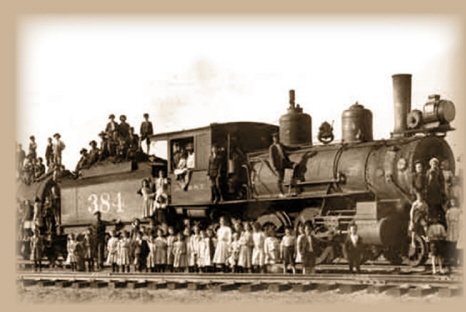
Between 1854 and 1929 an estimated 200,000 orphaned, abandoned, and homeless children were placed out during, what is known today as, the Orphan Train Movement. The name is derived from the children's situations, though they were not all orphans, and the mode of transportation used to move them across forty-seven states and Canada. Many of these children were adopted and grew up in loving homes, but many were treated as servants and worse.

Our family was lucky, when Emily Gendron Thibault died between 1875 and 1879 she left behind seven children, the oldest being between 12 and 16 and the youngest being between new born and four years old. Fabien was able to hold together the family, probably with the help of his siblings and his older children. In 1879 Fabien married again to Celina Miville Deschenes who died sometime before 1884 leaving behind three young children as well as her step children some who were still fairly young. Again Fabien managed to keep his family together and remarried a third time to Claire Banville in 1884.
Life for many of these orphan children weren't good, newspaper stories titled “Babies Sold Like Sheep,” telling readers that the New York Foundling Hospital “has for years been shipping children in car-loads all over the country, and they are given away and sold like cattle.” Charities attempted to guarantee successful orphan train placements by agreeing to remove children from failed placements and, where necessary, transport the child back to the charity’s Eastern office at the charity’s expense. Many children placed out west had survived on the streets of New York, Boston or other large eastern cities and generally were not the passive, obedient, respectful children that some families expected; this prompted placement changes and
returns to the East.
Numerous factors came together to end the orphan train movement in 1929. One factor was that railroad expansion in the United States was complete and most railroads ended subsidized fares provided to charities moving children. Another critical and underlying factor was that the need for labor which drove the initial success of orphan train placements in the West was no longer as great. The trains had relocated children to rural areas where their labor was needed on the frontier.
Another factor that contributed to the end of the orphan train movement was the backlash from the Western states. They reacted to their role as “a dumping ground for dependents from other states” by passing legislation limiting or prohibiting placement of out-of-state children. Many of these states had become urbanized and were facing their own child care and child placement issues. Cities such as Chicago and St. Louis began to experience the same problems in caring for neglected and destitute children that New York, Boston and Philadelphia had experienced in the mid-1800s. These cities began to seek ways to
care for their own orphan populations. In 1895, Michigan passed a statute prohibiting out-of-state children from local placement without payment of a bond guaranteeing that children placed in
Michigan would not become a public charge in the State. Similar laws were passed by Indiana, Illinois, Kansas, Minnesota, Missouri and Nebraska. Negotiated agreements between one or more New York charities and several western states allowed the continued placement of children in these states. Such agreements included large bonds as security for placed children. In 1929, however, these agreements expired and were not renewed as charities changed their child care support strategies.
Lastly, the need for the orphan train movement decreased as legislation was passed providing in-home family support. Charities began developing programs to support destitute and needy families limiting the need for intervention to place out children. State and local governments funded foster care for orphans while compulsory education and anti-child labor statutes were also being passed.
December 26, 2011

November 11, 2011

November 4, 2011
Coming to Amerikay
Patrick O'Conner was born about 1805 in Ireland he married Bridget McNamara sometime before 1830. Their first child was a daughter named Anne. She was born before 1830. She is my great great grandmother. Anne had at least 5 siblings 4 of whom were born in Ireland. Edward was born about 1836, Bridget 1837, Patrick 1840, and Alexander in 1846 all in Ireland. Lastly, Mary was born in 1849 in Vermont. This puts the time of immigration between 1846 and 1849. 1847 was the beginning of the Potato Blight. Given that there was such a large number of years between Anne's birth and Edwards, it is quite possible that there were other children who died, perhaps during the Irish famine or perhaps they died in route to the US. We can find no record of where the O'Conner's may have come from in Ireland but they first show up in the 1850 Census in Newbury, Vermont. Anne was not listed with them, instead she was found in Walpole, NH. Anne was next found in 1860 in Rockingham, VT having wed Thomas Lynch. Thomas Lynch was born in 1830 in Limerick Co. Ireland.
There are no records of a family of O'Conner's arriving by boat in America, perhaps they came in through Canada as during the Famine many families were thrown out of their homes and lands by landlords who packed them off on boats to Canada where the families then made their way to the US. Chicago and Vermont were common areas where the Irish entered as the states bordered the US.
Reading: Galloway Bay Mary Pat Kelly http://www.marypatkelly.com/content/index.asp
There are no records of a family of O'Conner's arriving by boat in America, perhaps they came in through Canada as during the Famine many families were thrown out of their homes and lands by landlords who packed them off on boats to Canada where the families then made their way to the US. Chicago and Vermont were common areas where the Irish entered as the states bordered the US.
Reading: Galloway Bay Mary Pat Kelly http://www.marypatkelly.com/content/index.asp
Subscribe to:
Posts (Atom)