January 4, 2018

88 Years ago today.....

...this little boy was born.  


Remembering Dad January 4, 1930 - December 10, 2009

November 28, 2016

The Civil War and Patrick O'Conner


O'Conner, Patrick, Age: 20, cred. Bennington, VT; service: enl 8/15/61, m/i 9/21/61, Pvt, Co. A, 4th VT INF, pow, Savage's Station, 6/29/62, prld 9/24/62, dis/dsb 10/16/62 Born: abt 1841, Unknown; Died: unknown; Buried: Unknown


From this we gleam that Patrick O'Conner age 20 enlisted in the 4th Vermont Infantry on 8/15/1861 and on 6/29/62 he was taken POW at Savage's Station to be released on 9/4/1862. He was listed as died of disease 10/16/1862


The 4th Regiment, composed of members from the eastern part of the state, was mustered into the U. S. service for a term of three years at Brattleboro, Sep. 21, 1861, and ordered at once to Washington. Co. A was composed mainly of members from Bennington county, and Windsor, Orange, Orleans, Windham, Washington and Caledonia counties were all represented. The regiment spent just a few days at Washington and moved on to join the other Vermont regiments, stationed at Camp Advance, Va. It was assigned to the Vermont Brigade. Gen. W. T. Brooks, 2nd division. Gen. William F. Smith, 6th Corps, and remained with this corps during the entire war. The original members not reenlisted were mustered out, Sep. 30, 1864. and the 1st, 2nd and 3d companies of sharpshooters were assigned to the regiment, Feb. 25, 1865. The losses of the regiment were so heavy that in spite of the large numbers of reenlisted men and recruits, it was consolidated into eight companies on Feb. 25, 1865. The 4th is mentioned by Col. Fox in his "Regimental Losses" as one of the "three hundred fighting regiments." The active service of the command opened with the campaign on the Peninsula early in 1862, followed by the battles of Antietam and Fredericksburg of that year, the "Mud March," Chancellorsville, Gettysburg, the Mine Run campaign, the Wilderness, Spotsylvania, Cold Harbor, the siege of Petersburg, the campaign against Early in the valley of the Shenandoah in the summer of 1864, and the final capture of Petersburg. The first winter was spent near the Chain bridge over the Potomac ; the second near Falmouth, Va. ; the winter of 1863-64 at Brandy Station, Va., and the final winter in the trenches before Petersburg. In all of the varied services of the Vermont Brigade, the 4th always played its part with steadiness and courage, meeting losses that were almost overwhelming. After the grand review at Washington in May, 1865, the regiment was mustered out (July 13), and received the welcome orders for the homeward journey.

The Battle of Savage's Station took place on June 29, 1862, in Henrico County, Virginia, as fourth of the Seven Days Battles (Peninsula Campaign) of the American Civil War. The main body of the Union Army of the Potomac began a general withdrawal toward the James River. Confederate Brig. Gen. John B. Magruder pursued along the railroad and the Williamsburg Road and struck Maj. Gen. Edwin Vose Sumner's II Corps (the Union rearguard) with three brigades near Savage's Station, while Maj. Gen. Thomas J. "Stonewall" Jackson's divisions were stalled north of the Chickahominy River. Union forces continued to withdraw across White Oak Swamp, abandoning supplies and more than 2,500 wounded soldiers in a field hospital.

Initial contact between the armies occurred at 9 a.m. on June 29. On the farm and orchards owned by a Mr. Allen, about 2 miles (3.2 km) west of Savage's Station, two Georgia regiments from the brigade of Brig. Gen. George T. Anderson fought against two Pennsylvania regiments from Sumner's corps for about two hours before disengaging, suffering 28 casualties to the Pennsylvanians' 119. The highest ranking casualty was Confederate Brig. Gen. Richard Griffith, who was mortally wounded by a Union shell fragment.  Magruder, who was alleged to be under the influence of morphine to combat a bout of indigestion, was confused and became concerned that he might be attacked by a superior force. He requested reinforcements from Lee, who ordered two brigades from the division of Maj. Gen. Benjamin Huger to assist, under the condition that they would have to be returned if they were not engaged by 2 p.m.
Meanwhile, Jackson was not advancing as Lee had planned. He was taking time to rebuild bridges over the Chickahominy and he received a garbled order from Lee's chief of staff that made him believe he should stay north of the river and guard the crossings. These failures of the Confederate plan were being matched on the Union side, however. Heintzelman decided on his own that his corps was not needed to defend Savage's Station, Sumner's and Franklin's being sufficient, so he decided to follow the rest of the army without informing his fellow generals.

Magruder was forced to give up the two brigades from Huger's division at 2 p.m. and was faced with the problem of attacking Sumner's 26,600 men with his own 14,000. He hesitated until 5 p.m., when he sent only two and a half brigades forward. Brig. Gen. Joseph B. Kershaw commanded the left flank, Brig. Gen. Paul J. Semmes the center, and Col. William Barksdale (Griffith's Brigade) the right. Franklin and Brig. Gen. John Sedgwick were on a reconnaissance to the west of Savage's Station when they saw Kershaw's brigade approaching. Their immediate assumption was that these were men from Heintzelman's corps, but they soon realized their mistake. This was the first indication of Heintzelman's unannounced departure and Sumner, for one, was particularly outraged, refusing to speak to Heintzelman the following day. Union artillery opened fire and pickets were sent forward to meet the assault


Magruder's attack was accompanied by the first armored railroad battery to be used in combat. Earlier in June, General Lee had hoped to counter the approach of McClellan's siege artillery by rail by using his own weapon: a 32-pounder Brooke naval rifle, shielded by a sloping casemate of railroad iron, nicknamed the "Land Merrimack." It was pushed by a locomotive at about the speed of the marching infantry.  However, even with this impressive weapon, which outgunned anything the Federal artillerists possessed, the results of Magruder's decision to send only part of his smaller force against a much larger enemy were predictable.
The first Union unit to engage was one of Sedgwick's brigades, Philadelphians led by Brig. Gen. William W. Burns, but his defensive line proved inadequate to cover the two brigade front of Kershaw and Semmes. Sumner managed this part of the battle erratically, selecting regiments for combat almost at random. He sent in two of Burns's regiments, and then the 1st Minnesota Infantry from another brigade in Sedgwick's division, and finally one regiment each from two different brigades in Brig. Gen. Israel B. Richardson's division. By the time all of these units reached the front, the two sides were at rough parity—two brigades each. Although Magruder had been conservative about his attack, Sumner was even more so. Of the 26 regiments he had in his corps, only 10 were engaged at Savage's Station.


The fighting turned into a bloody stalemate as darkness fell and strong thunderstorms began to move in. The Land Merrimack bombarded the Union front, with some of its shells reaching as far to the rear as the field hospital. The final actions of the evening were by the Vermont Brigade, commanded by Colonel William T. H. Brooks, of Brig. Gen. William F. "Baldy" Smith's division. Attempting to hold the flank south of the Williamsburg Road, the Vermonters charged into the woods and were met with murderous fire, suffering more casualties of any brigade on the field that day.  The battle was a stalemate at the cost of about 1,500 casualties on both sides, plus 2,500 previously wounded Union soldiers who were left to be captured when their field hospital was evacuated.

Patrick O'Conner was brother to Anne O'Conner our great great grandmother.  Anne married Thomas Lynch.  Daughter Mary Lynch married James Keefe.  Their daughter was our grandmother Josephine Keefe.

Books to read:  My Name Is Mary Sutter by Robin Oliveira

[Republished from October 2011]

December 4, 2015

Benjamin Hanks & Abigail Heiford Descendants

Note:  There is no proof that Benjamin Hanks is related to Abraham Lincoln

All of the branches of the Hanks Family in England and America seem to have come from the town of Malmesbury in Wiltshire.  

The Hanks family was an inventive group. At one time, they became the Nations largest producers of silk by importing the first mulberry trees from England and planting them in Connecticut and raising silk worms. Soon they invented and improved the apparatus for making silk into thread and constructed the first powered silk mill in the United States. The family built numerous forges 


 Benjamin Hanks migrated to New England about 1699. Benjamin Hanks married about 1700 Abigail Heiford daughter of John Heiford and Abigail  Albins. There is some confusion with LDS on the marriage of Abigail Heiford to a Thomas Washburn, this was Abigail Atkins Heiford not her daughter Abigail Heiford.  Benjamin Hanks and Abigail Heiford had 12 children.  Abigail died in 1726 and Benjamin remarried Mary Corbison Ripley widow of William Ripley.

Benjamin Hanks, Jr. son of Benjamin Hanks and Abigail Heiford was born July 16, 1702. He married Mary White in Pembroke Marshfield, MA, 23 Apr. 1724. Mary was the daughter of John Hanks' good friend Richard White. They moved to Sasquish Island (now Sasquish Head). On 1 May 1746 Benjamin Hanks of Plymouth, yeoman, for 275 lbs., sold to Lazarus LeBaron of Plymouth, physician, the whole of Saquish Island, together with a pew in the North West Gallery in the Meeting House of the first Precinct in the Town of Plymouth said Pew is a Wall Pew being in Number 14, and 10 acres of land in Duxbury; and his wife Mary released her rights of dower.This deed was recorded 13 May 1746. (Plymouth Deeds,: 56.) About 1746 Benjamin Hanks moved with his family from Plymouth to Mansfield, CT, where he had bought land in 1737. There at Chestnut Hill, afterwards known as Hanks Hill, he built the spacious house which is still standing and has always been known as "The Mansion House." It is an old fashioned house, with fourteen rooms on the ground floor, a great Iron frame in the sitting room, and in the parlor beyond panels three feet wide, brought from England.The parish records of Mansfield show that Benjamin Hank's wife "Mary White Hanks united with the first Congregational Church in Mansfield in 1746 having that same year sold their pew, No. 14, of the Meeting House of the first precinct in Plymouth." In "The Mansion House" on Hanks Hill, Mansfield, Benjamin Hanks lived the remainder of his life, and there he died some forty years after his removal to Connecticut. At his death he owned considerable land and many cattle.


Benjamin Hanks died in 1787 and his wife Mary dies in 1772. 


Uriah Hanks  son of Benjamin Hanks and Mary White was born 1736.   He married Irene Case daughter of Benjamin Case and Mary Manning March 18, 1755.  Uriah Hanks was the son of Benjamin and Mary White. During the Revolution, he made gunlocks, and is eligible to be claimed as a DAR or SAR patriot.  Uriah was said to be a large man, 6' 4" tall and to have born a resemblance to Abraham Lincoln. Lincoln's mother was a Hanks, but not closely related.  Uriah died on July 4, 1809 in Mansfield, CT and is buried in Storrs.   Irene died in 1807.


Benjamin Hanks, III was born October 29, 1755 in Mansfield CT to Uriah Hanks and Irene Case.   He married Alice Hovey daughter of Daniel Hovey and Elizabeth Slapp about 1775 in Windham, CT. He served as a drummer in Revolutionary War. In addition to clock making business, carried on goldsmith trade; made stockings, looms, compasses, brass cannon and large church bells. In 1779 removed to Litchfield, where in 1780 he built his home from which he carried on his business until 1790. His home served as one of Litchfield's early hotels. Removed to Mansfield CT where he "continued to make Clocks and Bells." In 1793 sold Amherst church its first bell. Set up second foundry for bell casting in Troy NY with son Truman, under firm name of BENJAMIN HANKS & SON. Received exclusive rights at October session of 1783 General Assembly to sell clocks wound by air. 


It is recorded that Benjamin learned the clockmaking trade from Thomas Harland, a noted Norwich clockmaker. Benjamin must have arrived at Harland’s doorstep with a solid mechanical background because his service with Harland had to be unusually short. Harland doesn’t arrive in Norwich until 1773 and Benjamin is said have been in the Boston area just before April of 1775. Why, well it is recorded that Benjamin served as a drummer during the Revolution and, in that role, took part in the march to Lexington in response to Paul Revere’s alarm. Shortly after, he enlisted or was assigned into General Israel Putnam’s Third Connecticut Regiment. Putnam was originally from Danvers, Massachusetts and move to Pomfret, CT in order to peruse inexpensive land. Putnam rushed north when he received news of the Battle at Lexington and Concord and joined the Patriot cause. He was a primary figure at the Battle of Bunker Hill. Perhaps Benjamin knew Putnam from his time in Connecticut? During this tumultuous time in our Country’s history, Hanks is said to have spent time working in a foundry owned by Paul Revere during and after the war. And yet, he still had time to married Alice Hovey about 1775 in Windham CT. (Alice Hovey was born on 15 Dec 1754 in Mansfield Center CT, christened on 19 Jan 1755 in Mansfield Center CT and died in Troy NY.


By 1777, at the age of twenty-two, Benjamin Hanks advertises form Windham, Connecticut as a Clock and Watchmaker and that he continued in the metal-smith’s trade making (according to an advertisement from the late 1770s) spurs, buckles, beads, hilts, clocks and watches, as well as general silver and gold work. In 1780, Benjamin moves to Litchfield, CT and builds a house and shop at 39 South Street to carry on his businesses. It is in the town of Litchfield that he performs the following accomplishments. Shortly after the move Benjamin is awarded the contract to make the clock for the Old Dutch Church at Nassau and Liberty Streets in New York City. In 1783, he petitioned the General Assembly for a patent for his invention of a clock wound automatically by air, and in 1785 advertised his clocks, Church clocks, pneumatic clocks, watches with center sweep seconds, surveyors’ compasses, etc. In 1786 he established a foundry and began casting large church bells. On the 6th of August 1787, Benjamin installs a bell in the Litchfield meeting house. The original one was broken. This bell was paid for by the society. In early 1790 he set up a “Brazier’s business.” In 1790, Benjamin moves to Mansfield where he continued to make clocks, bells and carried on the woolen business. In 1808 he and his son Truman form a partnership in the bell business and build a foundry in Troy, NY. The foundry made an assortment of items, including tower clocks, surveying tools, and church bells. One young man apprenticed at the Hanks’ West Troy foundry was Andrew Meneely who would later establish his own foundry in Troy and become one of America’s leading bell-makers.   Meneely is also buried in the Rural Cemetery in a family lot on the Middle Ridge. On the 4th of November, Benjamin was granted a patent for “Molding and Casting bells.”


Benjamin died 14 December 1824 in West Troy NY.  He is buried in Menands, Albany County New York.  Alice died January 27, 1836 in Troy NY.

Horatio Hanks was born October 1790 in Windham, CT to Benjamin Hanks and Alice Hovey.  He was a twin to sister Marcia who married Isaac Ooothout.  He married Jershua Freeman daughter of Frederick Freeman and Abigail Thompson in 1811.  Jershua is a possible descendant of William Brewster.

In 1810 Horatio Hanks erected with his uncle Rodney Hanks the first silk mill in america, where they began the manufacture of sewing silk and twist by means of machinery made by themselves and propelled by water power.  Until 1816 he lived in Mansfield, Connecticut, when he moved to West Troy, New York, where his father, Col. Benjamin Hanks, and his brother Julius were engaged in manufacturing bells, clocks, and mathematical instruments.  He remained with them until 1818, when he moved to Auburn, N.Y., and established himself as a manufacturer of jewels, theodolitis, transits, surveyors' compasses and other mechanical instruments.

 About 1826 he returned to Troy and began the manufacture of steam engines.  He afterwards engaged in the same business in Mattawan, Albany and New York.  in 1836 he moved to Cincinnati, Ohio, and went into business with Lucien B. Hanks and Jonathan S. Niles who were doing a large business in putting up cotton presses throughout the South.  in 1838 he moved to New Berne, N.C., where he bought a large saw mill and where he invented and first used the buzz saw.  He died in 1838 in Missisippi of typhoid fever.  Jershua Freeman died about 1856.


He had a patent:   HANKS, H. ET AL; FLAT BOILERS FOR GENERATING STEAM; NEW YORK NY 11 JUN 1829.

Sophronia Charlotte Hanks was born 10 March 1813 in Mansfield CT to Horatio Hanks and Jershua Freeman.  She married Orrin Trufant  son of David Trufant and Lydia Beal of Weymouth on September 19 1833 in Craven County, North Carolina.  In 1837 a daughter Lydia was born.  They remained in North Carolina until about 1838 when her father Horatio died and the relocated to New York where a son Edwin was born in 1839.  By 1843 their son Edgar* was born in Weymouth, MA.    Tragically Lydia died in 1859 in Weymouth and Edwin was killed  on April 2, 1863 in Gettysburg, PA during the Civil War.  Sophronia died 1 March 1887 in Braintree, MA.  Orrin died 5 March 1865 in Braintree.  


*Great Great Grandfather of David Reynolds
See also http://thibaultpinckneyreynolds.blogspot.com/2012/03/mayflower-descendant.html
http://thibaultpinckneyreynolds.blogspot.com/2013/08/presidential-relationships.html

February 27, 2015

Murder in Wrentham

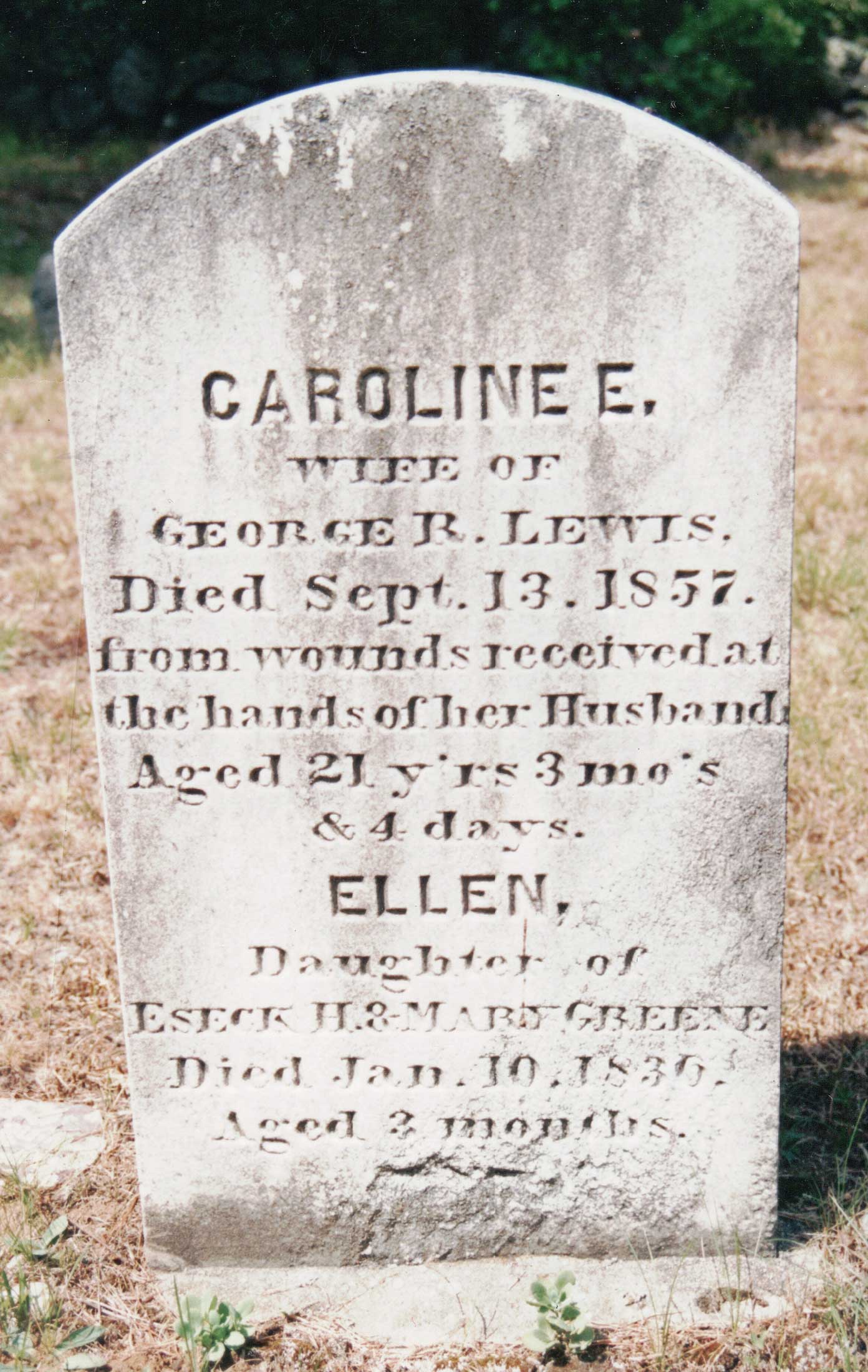
For over 25 years a grave stone in a graveyard behind an Italian restaurant in Wrentham MA haunted me.  On the gravestone were the words "Died from wounds received at the hands of her husband".  I wondered what happened that made the parents so angry as to put for all eternity these words on the stone of their beloved daughter.  She was only 21.  Today I discovered what happened.  The article of the times places blame on Caroline.  I want to note, the blame belongs in the hands of her husband and no other.  No matter what she might have done, she didn't deserve to die.  Census of 1860 George was in prison in Charlestown.


"Died Sept. 13, 1857 
from wounds received at
the hands of her husband”
From the Dedham Gazette on October 3, 1857:
"Caroline was killed by a shotgun blast to the chest in her mother’s home on West Street, on September 13, 1857, by her husband George who believed her to be unfaithful with a peddler by the name of Barrows.

George was a farm laborer, who worked on the farm of John A. Craig, Esg. a former Wrentham Selectman, who lived at 566 West Street.

He had previously separated from his wife after heated arguments but they were later re-united.

Caroline had know George from their schooldays. She had also known a somewhat older man, a peddler by the name of Barrows. At 20 years of age with with short curling hair, Caroline was considered beautiful, but had a bad reputation.

On the day of the murder George Lewis and the peddler Barrows had an argument and George went home in a rage, confronted his wife and struck her several times in the eye and face. She managed to escape with a horse and wagon and went to her mother’s home. George got a shotgun and followed her on his other horse. When George found his wife in the house he fired at her and missed, but the second shot hit her in the chest and knocked her to the floor. He then used the gun as a club and struck her in the head killing her outright.

When it was over he went to the farm of his employer and reported what he had done.

George R. Lewis was reportedly a mild and inoffensive man and had always Bourne a good character even though his mother had been divorced and married a black.

The sympathy of the people of Wrentham were with him at the time of the trial. He pled guilty to manslaughter.”

http://www.findagrave.com/cgi-bin/fg.cgi?page=gr&GSsr=161&GScid=2280175&GRid=131382333&


May 24, 2014

Remarks of Remembrance

Remarks of Remembrance
Helen E. Thibault
11/14/1929-5/12/2014


Thank you all for being here to share with us in remembering Helen. Helen valued her relationships with family, she was a daughter, a sister, a beloved wife, a mother, an aunt, a mother-in-law, and as I knew her a loving Grandmother – Grammy.

She was a woman of unwavering faith who valued the church, its teachings, and its community. Helen, was a modest woman, who had strong morals and convictions, and who lived by them – to paraphrase a remark I heard her sister Laurie make, she always “did right”.

As my Aunt Marie pointed out, Helen lived a long life, through challenging and changing times, from the Depression, to World War II, to the Baby Boom and beyond. She experienced the impact of these world events as well as the personal struggles and joys, - the ups and downs of life - and felt them all deeply.

I would be remiss if I did not mention Grammy’s love of reading; novels, biographies, the Globe – always learning- or her enviable garden of blooms. We will all miss her unsurpassable apple pie crust, and the comfort brought by a bite of her chocolate chip cookies.

I admire her travels, whether it was stories of she and Grampy packing up the kids for some time at the beach, or to theme parks with grandkids – where she always rode the thrill rides, romantic getaways with Grampy to Hawaii or on a cruise, the adventures of church trips across Europe and Canada, and in later years, relaxing visits with family.

But what I keep coming back to, what I am hearing repeatedly from others, what is evident throughout her life, is that Grammy loved - and was loved- by her family.

She and her husband Joe – Grampy, loved each other immensely, I’ll remember how she carefully prepared cups of tea for Grampy after dinner, and secretly reading the greeting cards they wrote to each other displayed in the living room, full of personal, handwritten, sweet, romantic sentiments, which sometimes caused me to blush and cry simultaneously

We were all blessed by her unconditional love and support. She welcomed new family members – children, nieces, nephews, spouses, grandchildren, great-grandchildren, expected or a surprise- biological or otherwise – lovingly with open arms, happy to share in their lives.

She was always connected to her family; she looked forward to and recounted excitedly her frequent trips to the movies with her sister, Laurie. She sent cards at every holiday, and even learned to email.  Her telephone conversations were prolific – she had a regularly scheduled nightly phone call with her daughter Janice. My cousin Erica reflected on their 2-hour long telephone gab sessions, and I’m sure Gram loved every second of catching up.

She let you know that you were important, that you were cared for, my mother remembers Grammy never ended a telephone call without saying I love you. I am sure many others here today have memories of her detailed conversations, how she delighted in hearing about your recent updates in life and telling you about her own.  

She was always there along the way to share in our triumphs, comfort us through illnesses, and support us through hardships, no matter what.

We all had special moments with her, whether she stood proud with you at first communion, an athletic contest, a concert, your graduation, your wedding, or simply read a story with you, played a game, took you to the movies, went to the park and pushed you on the swings, or lovingly gave you a hug. In her final days she was tired, preparing for rest, but was still Wowed by a photo of her great-granddaughter, Emily, on her way to prom.

Many more special moments will come in our lives, I hope we all know that she is proud of us, that her spirit is with each of us, through successes, and trying times. From Gram’s life, let’s take with us the importance of family, of connection, of opening our arms, and loving without conditions.

May we be at peace by the knowledge that her love and care for other was returned, that she was cared for and surrounded by family through the end, that she is rested, without pain, and together again with the love of her life.

May we live our lives to love, remember, and honor, Helen, Mom, Grammy.

Thank you.

Remembrance eulogy given May 16, 2014 by Jackie Knoblock

January 10, 2014

It's a small world...

Last night I was looking over my husband's tree and was trying to find information on his grandmother's side of the family.  I found her great grandparents and then found a dit name that sounded very familiar.  Further research led to the first of the family to enter from France then to his parents.  I went to my tree and found the familiar dit name and went up that side of the tree further than I had previously and found the same couple.  On further examination I found their son, who I found in my husband's tree, was married 3 times.  His first wife died and he married my 8th great grandmother.  She later died and he married my husband's 7th great grandmother.  This man is my 8th great grandfather and my husband's 7th great grandfather.  This is probably not unusual in the sense that many French-Canadian's are related except for the fact that this is the only French Canadian line in his mothers family of mostly Mayflower descendants and other English immigrants.    I told my husband but I don't think he was thrilled ;-)

November 22, 2013

Hélène Desportes

Hélène  Desportes is our first double grandmother.  Her first marriage was to Guillaume (William) Hebert son of Louis Hebert and Marie Rollett.  Guillaume was born in Paris in 1604 and emigrated in 1617 at the age of 13 with his parents and siblings.  He was the grandson of Nicholas Hebert apothocary to Catherine DeMedici.   His father Louis was an apothocary and friend to Samuel Champlain.  The circumstances of their arrival was deceitful.  Having been offered the position of physician receiving 200 pounds for 3 years he was met with a new contract that he would receive only one hundred crowns a year for three years and when the contract expired, he must serve the Company and Exclusively for nothing. He Was forbidden to engage in the fur trade and if he farmed, he must sell to the company at prices they would fix.  Having sold his apothocary business in Paris he was forced to accept.

Back to Hélène Desportes our double grandmother.  Hélène was born in about 20 July 1620 in Quebec who may or may not have been the first white child born in Quebec.  There is some dispute whether she was born in Quebec or France. Hélène was daughter of Pierre Desportes and Francois Langlais.  Her godmother was Madame Hélène Boullé, the wife of Samuel de Champlain. In his will, Champlain left her 300 livres (about $15,000 in 1997).  After the fall of Québec City in 1629, Hélène and her parents, along with Champlain were transported to London, and then back to France. Shortly after peace was restored in 1632, Hélène returned to Québec, possibly with Champlain who arrived back in Québec on May 16, 1633.

On the first of October 1634, Hélène married Joseph Guillaume Hébert, son of Louis Hébert and Marie Rollet. Joseph's family had remained in Québec during the occupation and had the first farm there. His father Louis Hébert had been involved in early expeditions to Port Royal with Champlain and others.  Helene and Guillaume had 3 children:  Joseph, Angelique and Marie Francois.   Marie Francois married Guilaume Fornier who were our 9th great grandparents down to our Great Grandfather Magloire Thibault.  Marie Desportes was our 10th great grandmother on this side of the tree.

After Joseph Hebert died in 1639, Hélène was left with three living children. She then married Noël Morin, a native of the parish of St-Étienne in Brie-Comte-Robert, a village near Paris, on January 9, 1640, in Quebec City. They had 12 children one of who was Agnes Morin who married Ignace Bonhomme dit Beaupre.  They were our 8th great grandparents down to our Great Grandmother Delia Beaulieu.  Marie Desportes was our 9th great grandmother on this side of the tree.

This makes Marie Deportes our 10th Great Grandmother on the Thibault side of the tree and our 9th great grandmother on the Beaulieu side of the tree making Delia and Magloire distant cousins.


September 11, 2013

First Catholic Mass Held in Town of Southbridge

Hugh Murphy and Elizabeth Owens Murphy were our 3rd great grandparents.  They were the first Irish family to move to Southbridge and held the first Catholic mass in their home.  They are parents of our 2nd great grandmother Mary Ann Murphy who married James O'Leary.  Pictured is Mary Ann's brother Hugh.


August 30, 2013

Presidential Relationships

When one thinks of being related to a President you might think it's through Mayflower passengers since it seems many Presidents are descendants of the Mayflower but I recently found that my husband is related to the Bush's through John Horton and Mehitable Garnsey. He is 8th cousin to the senior George and 8th cousin 1x removed from George Walker Bush. John Horton is descendant of one of the original Horton's to come from Mowsley, Leicestershire, England. Who are you related to?


August 1, 2013

Dead Ends Become New Roads

When you think you've discovered all you can you find out,  there are new leads.  If you think your ancestor came over alone, think again.   I was at a dead end, not knowing our great great grandmothers last name.  By the marriage certificate of our great grandfather James Arthur Keefe and Mary A. Lynch we knew his father was Arthur Keefe and his mother was Honora G.  No last name.  His death certificate provided no additional information as it didn't list his mother at all.  Dead end?  Nope.  We knew Arthur was born in Ireland and came over around 1871.  We knew he was born about 1850.  We knew where he married and where he lived and where he died.  Ok so what?  Well search Keefe born between 1845 and 1855 living in the two places that Arthur lived.  Plug in parents as Arthur Keefe and Honora.  Up pops a Margaret Keefe who died in 1904 who married a James Hartnett.  Look at her death certificate and her parents are listed as Arthur Keefe and Honora Grady.  Did we just find James' sister?  Look at her marriage certificate and she got married in the same town as James and Mary.   Looks like, indeed, we did find his sister and in turn found our Great Grandmother.

July 9, 2013

The more things change the more they stay the same

Marguerite Bouchard born 10 May 1674 to Michel Bouchard and Marie Trottain had 4 children, all by different husbands of which only one she married.  Who is Marguerite Bouchard?  She is the daughter of our 9th Great Grandfather and sister of our 8th great grandfather and our 8th great grandmother Ettiene Bouchard and Marie Madeline Bouchard.  Ettiene is ancestor of Joseph Beaulieu while Marie Madeline is ancestor of Emily Berube wife of Joseph.

Marguerite's first child Jean Pierre Gagnon was born September 17, 1693 son of Jean Gagnon our 8th great grandfather.  Jean Gagnon was accused of giving Marguerite drugs to induce a miscarriage and of rape.    Whether or not this was true Jean Pierre was born and Jean Gagnon was ordered by the courts of the time to provide for him.  It appears that Jean Pierre never lived more than 20 days with his mother and was raised by a Nanny until he was 20 paid for by Jean Gagnon.  An agreement was drawn up February 27, 1694 before the notary Chambalon.

On October 19, 1696 Marguerite gave birth to a baby girl named Marie-Francois Dubroc.  She was the daughter of Francois Dubroc a merchant of Bayone who Marguerite was not married to.  On July 29, 1697 Marguerite married Francois Dutartre after an agreement is signed before the notary Chambalon whereby Dubroc Dutartre was to pay 300 pounds in return for which the latter agrees to take care of the little girl as if she was his own daughter.  On May 11, 1698 Marguerite again gives birth to a son Francois Dutartre.  Dutarte, however, never knew he has a son as he abandoned her for France where he remained for the rest of his life.  On July 13, 1709 in what seems to be a case of debt Marguerite states that Francois Dutartre had been absent from the country for 12 years.  Francois never lived up to his agreement before the notorary.

Her last child Jean-Baptiste (Guillaume) Soucy was born born July 21, 1704.  His father was William Soucy, a single son of Jean Soucy dit Lavigne and Jeanne Savonnet.  Jeanne Savonnet was our 8th Great Grandmother whose second husband was Damien Berube our 8th Great Grandfather.

All this makes us wonder about Marguerite.  What motivated her.  We know her father was a barkeep and her mother Marie Trottain (Trotin) was convicted with 2 other women of spanking a man.  Marie was also a "Kings Daughter", one of many girls who were sent over from France as marriageable women for the Canandian colonists.

Her sister Marie Madeleine married Pierre Dancoss (Dancause) when she was 14 and had 8 children before Pierre died.  She was engaged to François de Serre (Cyr) September 22, 1699 and gave birth to a baby girl Marie Anne Bouchard de Serre on June 17, 1700.  Tanguay states that the couple were never married, however the baptismal record she is the "fille de ( ) de serre & de Marie Madeleinne Bouchard veuve de feu (widow of) Pierre Dancosse...".  No first name and no indication that they weren't married.  No further records exist of Francois de Serre.  Did he die?  Did he run off?  

June 7, 2013

Murder in War


On 28 February 1759, Lieutenant Hazen and about fifteen men arrived at Point Sainte-A nne. The well-armed group surrounded the first three houses of the village, perhaps with five soldiers at each house. They took some of the occupants captive, including Joseph Bellefontaine, the 64 year old son of Barthélémy's old friend Gabriel Godin and good friend of Michel Bergeron dit de Nantes. They also captured Joseph's wife, Anne Bergeron, his 26 year-old son Michel and wife Madeleine Guilbault, his daughter Nastasie and her husband Eustache Paré (a ge 25), and four of his grandchildren. The English tied Joseph and Michel Godin to trees and proceeded to slaughter their kin in front of them.


In 1774 Joseph Godin-Bellefontaine himself wrote a long mémoire and detailed the massacre of his family by Lieutenant Hazen and his soldiers. "Every human soul will be, as he, much affected by the horrible massacre of a part of his family, of which they had the harshness of making him a witness, he and his son Michel bound, their hands behind their backs and tied to some trees, they repeated to him over and over that he and all his family had to submit to English domination and to swear an oath of fidelity to their King. He persisted in the perseverance of his refusal, they took their rage to the point of massacring his daughter Nastazie, wife of Eustache Paré, crushing her head with a blow of the butt of a gun, his two children and a son of Michel, and splitting the head of the wife of the latter with a blow of a hatchet. During this barbarous scene, Anne Bergeron, his wife, and Eustache Paré, his son-in-law, each took one of the said Paré's children in their arms and only saved them from the fury of these cruel men by their flight into the woods with that which they had on their bodies , without having time to take old clothing or provisions or papers."

Joseph Godin-Bellefontaine is our 8th great uncle.

LE GRAND DÉRANGEMENT

Maurice Godin of Namur, present-day Belgium, married Huguette Pampelune of Sedan, France, in c1560.  Their son Vorle married Brigitte Gouzier of Bar-sur-Seine, Champagne, in c1595.  Vorle's son Claude married Marie Bardin of Savolles, Champagne, before July 1624, when daughter Jeanne was baptized at St.-Vorle de Châtillon-sur-Seine.  

Claude's son Pierre, born at Châtillon-sur-Seine in May 1630, emigrated to New France in his early 20s.  He reached Montréal in September 1653 and married Jeanne, daughter of Louis Rousseliere, in October 1654.  Like his father, Pierre dit Châtillon was a master carpenter.  He and Jeanne left Montréal in 1664, lived at Charlesbourg near Québec, where they were counted in 1666, then at Québec, returned to Montréal in the 1670s, and went to Chignecto in Acadia probably with the sieur de La Vallière, the seigneur of Beaubassin, between June 1676 and June 1677 "to continue the construction work already under way."    Pierre died either at Port-Royal or Chignecto in the early or mid-1680s, in his 50s (only Jeanne, called "widow of Godin," and three of their children, appear in the Acadian census of 1686).  He and Jeanne had nine children, including four sons, three of whom created families of their own.  


The only branch of the Godin family in New France affected by the Acadian Grand Dérangement was that of Pierre dit Châtillon's second son, Gabriel dit Châtillon.  

Gabriel dit Châtillon, later sieur de Bellefontaine, born at Montréal in July 1661, married Andrée-Angélique, daughter of Robert JasneJeanne, or Joannes, at Québec in July 1690.  Gabriel lived at Charlebourg, Québec, when he was young and was counted at Port-Royal in the late 1680s.  He and his wife settled on Rivière St.-Jean  now New Brunswick, where French authorities had given Gabriel a seigneury.  He and Andrée-Angélique had 12 children on Rivière St.-Jean, including eight sons.

Oldest son Louis dit Bellefontaine, born in c1693, married a woman whose name has been lost to history, in c1736.  Louis died at St.-François-du-Lac, Québec, in February 1749, age 57.

Joseph dit Bellefontaine dit Beauséjour, born in c1695, married Marie-Anne, daughter of Barthélémy 
Bergeron dit d'Amboise, at Rivière St.-Jean in c1726. Joseph served as a major of the local militia during King George's War in the late 1740s. He died at Cherbourg, France, in December 1776, age 81. His daughter, daughter-in-law and grandchildren were brutally slain by Lt. Hazen.


Jacques-Philippe dit Bellefeuille, born in c1697, married Anne-Marie, another daughter of Barthélémy 
Bergeron dit d'Amboise, probably at Rivière St.-Jean in c1730. Jacques-Philippe died at Gentilly, Québec, in February 1763.


Pierre-Joseph dit Châtillon dit Préville, born in the late 1690s or early 1700s, married Marie-Josèphe, daughter of Alexandre Bourg, at Grand-Pré in August 1730.  Pierre-Joseph died in January 1745, before Le Grand Dérangement.  


Jean-Baptiste dit Lincour, born in the early 1700s, married Anastasie, another daughter of Alexandre Bourg, in c1729.  Jean-Baptiste died during Le Grand Dérangement, perhaps at Halifax, where British authorities counted his wife and four children in August 1763 and called her a widow.


Charles dit Bellefontaine dit Boisjoli, born in c1708, married Marie, daughter of Charles Melanson, at Port-Royal in August 1735.  British authorities counted him and his family also in the prison at Halifax in August 1763.


René dit Jean-René dit Valcour, born in the late 1700s or early 1710s, married first to Françoise Dugas in c1734, and then to Françoise, yet another daughter of Barthélemy Bergeron dit d'Amboise, probably at Rivière St.-Jean in c1743.  
Youngest son Bonaventure dit Bellefontaine, born in c1715, married first to a woman whose name has been lost to history, in c1739, and remarried to Marguerite, yet another daughter of Barthélémy Bergeron ditd'Amboise, probably at Rivière St.-Jean in c1740.  

LE GRAND DÉRANGEMENT
Le Grand Dérangement of the 1750s scattered this large family from France to Louisiana

Living in territory controlled by France, the Godins of Rivière St.-Jean escaped the British round up of their fellow Acadians in Nova Scotia in the autumn of 1755.   In September 1758, British forces raided the Rivière St.-Jean valley and destroyed the settlements there, including Ste.-Anne-du-Pays-Bas with its church and 147 houses.  Gabriel dit Châtillon Godin's descendants survived the onslaught as best they could.  In February 1759, second son Joseph dit Bellefontaine dit Beauséjour and his family were captured by New English rangers, who forced Joseph to watch as they killed his daughter and children and his daughter-in-law.  After being held as prisoners of war at Halifax, Joseph and the rest of his family were deported to France in 1759.  Gabriel dit Châtillon's third son, Jacques-Philippe dit Bellefeuille, and his family escaped the British and fled north to the St. Lawrence valley.  Gabriel dit Châtillon's second daughter Marie-Yvette, wife of Michel Saindon, also dodged the British and returned to Rivière St.-Jean at the end of the war, but moved on to the St.-Lawrence valley, where she died in April 1795, age 86.  Meanwhile, Gabriel dit Châtillon's younger sons, Jean-Baptiste dit Lincour, Charles dit Bellefontaine dit Boisjoli, and Bonaventure dit Bellefontaine, and their families escaped the British and moved northeast to Miramichi  and then to Restigouche on the Gulf of St. Lawrence shore, where they joined other Acadian refugees.  Their sisters Marie-Charlotte, wife of Jean Dugas, and Angélique, wife of Pierre Part, also sought refuge on the Gulf of St. Lawrence shore.  In the early 1760s, British forces captured Miramichi and Restigouche and sent hundreds of Acadians, including the Godins, to prisoner-of-war compounds in Nova Scotia, most of them to Halifax, where they were confined for the rest of the war.  
.
After the war with Britain finally ended in 1763, descendants of  Gabriel dit Châtillon Godin settled near their cousins in the St. Lawrence valley and at various places in what became the Maritimes provinces.  

Names in Red are our ancestors

May 15, 2013

From Ireland to Massachusetts to Wisconsin

I had a small mystery on my hands and it involved why two brothers moved from Massachusetts to Wisconsin.  This family had immigrated to America from Ireland and in particular the Boston suburbs in the early 1850's but by 1867 two of the brothers married sisters and moved to Wisconsin.  Why?  It was after the Civil War and I wondered if that had anything to do with it.  A google search for what might have been going on in 1867 in Wisconsin turned up a unique immigration plan targeted on European immigrants.  Not only did they go overseas and distribute pamphlets about Wisconsin but also they went to the East coast and targeted the Irish and other immigrants to come to Wisconsin.  In 1855 Wisconsins were getting a little uptight about the foreigners and an end to the commission was brought about but it seems in 1867 that the commission was brought back and again in 1895.

Wisconsin government officials tried to encourage settlers to come to the state several times in the 19th century. They employed a commissioner or a formal board of immigration during the years 1852-1855, 1867-1887, and 1895-1901. In 1867 Gov. Lucius Fairchild persuaded Milwaukee author Increase Lapham to write a 38-page pamphlet entitled, "Statistics, Exhibiting the History, Climate, and Productions of the State of Wisconsin" to be distributed to prospective immigrants in the eastern states and in Europe. Lapham finished this pamphlet in July, 1867, and over the next several years, translations and revised editions appeared in German, Norwegian, French, Dutch, Swedish, and Welsh. More than 90,000 copies were published in all, some of them printed and issued directly in Germany, Holland, and England to save shipping costs. http://www.wisconsinhistory.org/turningpoints/search.asp?id=1701

The interesting thing is that if my Great Great Grandmother had left Massachusetts with her brothers I wouldn't be here and if they stayed their descendants wouldn't be here either.  

April 9, 2013

Double Cousins

My sister and I were "talking" the other day about cousins on my father's Irish side of the family.  In digging further we discovered that they are also cousins on our French-Canadian side, both French-Canadian sides, my Great Grandparents.  While being related on both sides of the French-Canadian tree is not unusual, it is unusual to be related at the same time on our Irish side.  On the Irish side they are 1st cousins 1x removed and though it's hard to figure out the exact relationship on the French-Candian side it's much futher back as we share 7th Great Grandparents through our Great grandmother Delia and 8th Great Grandparents through our Great Grandfather Magloire.  The world is definitely small.

December 24, 2012

Christmas Eve with our Ancestors


Christmas Eve for French-Canadians is known as the réveillon (literally, “awakening”), a feast that followed midnight mass and ushered in Christmas Day. Traditional food is the tourtiere or meat pie.


In German it is Heiliger Abend. The festival is usually celebrated in the family circle. In Germany it is common to eat potato salad with sausages or a similarly simple meal, but also more complex dishes such as goose or carp are common. A traditional Christmas Eve meal consists of carp (a type of fish), potato salad, boiled potatoes, cucumber salad and lemon slices. Germany is credited with starting the Christmas tree tradition as we now know it in the 16th century when devout Christians brought decorated trees into their homes. Some built Christmas pyramids of wood and decorated them with evergreens and candles if wood was scarce. It is a widely held belief that Martin Luther, the 16th-century Protestant reformer, first added lighted candles to a tree. Walking toward his home one winter evening, composing a sermon, he was awed by the brilliance of stars twinkling amidst evergreens. To recapture the scene for his family, he erected a tree in the main room and wired its branches with lighted candles.

In Ireland it is Oíche Nollag.  Christmas Eve is traditionally a day of fasting in Ireland followed with a small evening meal of fish and potatoes. After evening meal on Christmas eve the kitchen table was again set and on it were placed a loaf of bread filled with caraway seeds and raisins, a pitcher of milk and a large lit candle. The door to the house was left unlatched so that Mary and Joseph, or any wandering traveller, could avail of the welcome.


Recipes:

  Tourtiere:  http://www.ediblecommunities.com/southshore/winter-2011-2012/edible-celebrations-wake-up-and-party-french-canadians-on-christmas-eve.htm


  Irish Christmas Cake http://www.irelandforvisitors.com/recipes/blccake.htm


and all that food needs to be followed up with Gluehwein (you can make it with red or white wine) http://www.vistawide.com/german/christmas/gluehwein_recipe.htm

August 24, 2012

The world is a small place

Recently I've been corresponding with a 2nd cousin once removed.  We are related on our Irish side.  I found out her mother's second husband, her father, was French Canadian descent so I backed up her tree and found a familiar town and a familiar name.  So, we are very distantly related on our French-Canadian side as well as our Irish side.  Small world and what you learn from dead ancestors.

August 7, 2012

I See Dead Relatives


Finding your relatives in old cemeteries is like finding a needle in a haystack.  Recently we went searching for relatives in Provincetown, MA but unfortunately did not come across them.  There were three town cemeteries and until we got home we weren't sure which one they were in.  It is believed they are somewhere in this cemetery pictured.  We did come across a distant cousin though.

June 29, 2012

More on Internments

By the spring of 1917, so much of Canada's workforce had entered the armed forces that industry and agriculture were severely short of labour. As a result, all able-bodied internees were paroled from the internment camps to work in factories, railway camps and mines. Parole conditions included travel restrictions and required parolees to carry identity cards and report regularly to local authorities. Those assigned to railway labour in northern Ontario experienced conditions as hard as in the camps. Some 1,300 prisoners were paroled from Kapuskasing that spring. Approximately 60 men remained in camp for health or security reasons. They were soon joined by 400 prisoners of war transferred from the Fort Henry internment station. To hold these more dangerous inmates, high barbed-wire fences were erected around the camp and a stricter regime was instituted. Soon the camp's population again rose to over 1,200 prisoners. The majority now were German prisoners of war, mostly sailors and merchant seamen taken from German ships in the Caribbean.

Why was Fredrich Gerull considered "dangerous"?   Most likely he was just a merchant seaman like Grandpa who got caught in the wrong place at the wrong time.

Update:  Fredrich was most likely in the German military and was captured and interred on behalf of England in Canada.